eric the fruitbatBlog
Sounding out the Noosphere.

Bio

Presenting Science

Posted by Eric Hennigan
On August 27th, 2009 at 01:08

Permalink | Trackback | Links In |

Comments (4) |
Posted in Bio, Education, People, Politics, Religion

Today I stumbled across a somewhat recent post by Luskin of the infamous Discovery Institute. Luskin observes some comments made by Eugenie Scott, in regard to how scientists should portray their results, so as not to be pounced upon by the creationists. He accuses Scott of instructing scientists to “spin it [changes in science] positively and never acknowledge they were wrong”. Worse, he concludes with:

When scientists in a field are instructed to avoid publicly admiting when they’re wrong, and are advised that improving the public’s perception of science is not best served by doing better science, then you know that field is steeped in intolerance towards dissent, and political pressure to give assent to orthodoxy. These are not the signs of a healthy science.

Which, while technically an accurate statement, is very misleading in this context. When we look at what Scott actually said, she’s effectively counseling scientists to be careful about their phrasing. Importantly, those working in evolution should avoid hyperbole about their discoveries. She wants scientists to be aware of the following problem:

So people get confused when scientists discover things and change ideas?

Yes, all the time. This is one of the real confusions about evolution. Creationists have done a splendid job of convincing the public that evolution is weak science because scientists are always changing their minds about things.

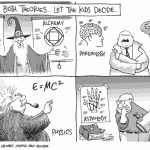
So, Luskin (and other creationists) are actually responsible for Eugenie’s reaction! They’ve been pouncing all over science, politicizing evolution with a “Teach the controversy” campaign and continuous whining about “being blacklisted from the journals”. They’ve been rejected from journals because they have no falsifiable claims, nor associated experiments; they then tried to push the creationism into schools, but were thrown out in the Scope’s Monkey Trial and again in Dover, Pennsylvania; and now they’ve jumped on an “equal-time in science classrooms” even though the comparison is akin to astrology vs astronomy.

Chemistry vs Alchemy, Phrenology vs Psychology, Astrology vs Astronomy, Creation vs Evolution, Let the kids decide!

This has really gone on for long enough that Eugenie feels she must remind scientists that:

What’s the current state of the effort to keep schools teaching evolution?

Sometimes it feels like the Red Queen around here, where we’re running as hard as we can to stay in the same place. The thing is, creationism evolves. And for every victory we have, there’s pressure on the creationists to change their approach. We constantly have to shift our response. Ultimately the solution to this problem is not going to come from pouring more science on it.

What should scientists and people who care about science do?

I’m calling on scientists to be citizens. American education is decentralized. Which means it’s politicized. To make a change … you have to be a citizen who pays attention to local elections and votes [for] the right people. You can’t just sit back and expect that the magnificence of science will reveal itself and everybody will … accept the science.

Though Luskin takes warps these comments to imply that science itself isn’t healthy, he should be reminded that the whole political situation is the fault of the creationists! They’ve got a strategic attack with the Wedge Document that’s mostly taken the scientific community by surprise. Then, when scientists make outrageous claims (like when New Scientist had a cover proclaiming Darwin was Wrong) the creationists blow it all out of proportion. That’s why Eugenie is recommending that scientists not try for these kinds of claims; it’s inaccurate and the distortion is too easily inflated by creationist cohorts.

So, Luskin, like all creationists before him, has once again reversed cause and effect and confused his premise and conclusion. It’s not that science is dogmatic because Scott has to encourage carefully worded discoveries; It’s that the political climate surrounding evolution has become so highly charged that it can no longer tolerate the hyperbole that scientists naturally inject into their claims to sell their importance to other scientists. And the entire problem was manufactured by the creationists! And Luskin continues to flame the distortion in his post that prompted this whole rant.

Oh, and one more thing: Any time that a creationist claims the Earth was created in 6,000 years, point them over to Yes, Millions of Years! and then ask who’s rejecting what evidence!

Weakening of the Teleological Argument

Posted by Eric Hennigan
On April 15th, 2009 at 12:04

Permalink | Trackback | Links In |

Comments (4) |
Posted in Bio, Philosophy, Physics, Religion

Wikipedia defines the Teleological Argument as “an argument for the existence of god based on perceived evidence of order, purpose, design, or direction — or some combination of these — in nature.” I’ve always found it a really tough one to battle. William Lane Craig used it in a recent debate with Christopher Hitchens. He set it up like follows:

  1. The fine-tuning of the universe is due to either law, chance, or design.
  2. It is not due to law or chance.
  3. Therefore, it is due to design.

I admit that my response was weak. I argued that the order perceived, is just that perceived! Unraveling this confusion leads us to curious and subtle reversal of naive logic. First, the anthropic principal states that we’d expect to see an ordered universe if order was a prerequisite for life. But the human mind works in such a way that we’d also have a solipsistic tendency to think that the presence of such order implies it was all designed ‘with us in mind’. But this reasoning is a bit flawed. It’s like a puddle waking up, and realizing that the pothole is shaped ‘with it in mind’.

A real understanding of the issue demonstrates what appears to be a reversal in logic. This is mostly why people fail to really understood the the evolutionary story. Daniel Dennett is fond of pointing this reversal out in his talks: “sugar is sweet because we like it” not “we like sugar because it is sweet”. It’s much easier for us to apply a naive logic and take the solipsistic path rather than the more subtle correct one.

None of this ever convinces the creationists though. They come biased with that solipsistic assumption, and pointing out the logical reversal never seems to raise the obvious flags of logical inconsistency or cause cognitive dissonance. It’s just too subtle a point it, it doesn’t adequately challenge the assumption that’s so deeply enmeshed in their understanding of the world as to be inviolate.

Now, though, some nice physicists have come up with some better measures on the amount of order necessary for life. Craig argued that if just one of the fundamental constants was off by as much as a millionth there’d be no life. I remain unconvinced, because I’m skeptical about what order is necessary for life. I don’t want to limit life to being ‘carbon-based’, or qualify the probabilities with ‘life as we know it’. But, the physicists have uncovered some robustness that hasn’t been talked about before. They argue that life, even life ‘as we know it’ may be a bit more flexible with regard to the fundamental constants, we don’t need as much ‘fine-tuning’ as is popularly believed. This is an excellent effort, because it attacks the Teleological argument right where it’s weakest: the underlying probabilities. Their argument also meshes with my personal belief that life, as an emergent property, finds a way!

Speech on Chaos Theory and Ecological Stability

Posted by Eric Hennigan
On February 16th, 2009 at 16:02

Permalink | Trackback | Links In |

Leave a Comment |
Posted in Bio, Math, Self

I wrote this speech on the way to an Academic Decathlon competition in high school. I still like it, but see now that I really should have been speaking of path lines in attractor fields. Other than that very important mistake, and the fact that you have to have a good idea of what I’m discussing in the first place. I’d say it was a good speech for me at that time. I know the premise is wrong, I knew that when I wrote it. I just wanted to go against the popular opinion.


I’ve been hearing a lot lately about Global Warming, overpopulation, encroachment, and Deforestation. So far, scientists have predicted the hazardous effects that these problems have on the Earth. Although I’m not denying that we might harm the environment that sustains us, We cannot accurately predict what the effects of these actions might be, due to the fact that natural systems exhibit chaos in their cycles.

For example, consider a population consisting solely of wolves and rabbits. Within this population there exist a number of equilibriums. 1st; a constantly alternating number of wolves and rabbits. 2nd; a continuous and unchanging number of wolves and rabbits. and 3rd; the most stable of all, Death. Should we put this on a graph it would be evident that each of these existences or nonexistence, as the case may be, is “fighting for control” of the system. This results in a chaotic behavior of the system, as it oscillates between each of the 3 attractors.

On our graph of the wolf and rabbit population we can represent the system with a little dot in the middle of a complex attractor field. In this scenario there are 3 attractors, one for each equilibrium. Changes in the system due to human interaction and intervention can alter the placement of the system into the domain of a different attractor. Since we can never know everything that would be necessary to accurately graph the regions of the attractors, specifically the borders, we cannot predict what effects we really have on the environment, harmful or not.

All systems in nature from biological population to weather systems have a tendency to exhibit this type of chaos. In fact, without this ‘chaos’ the system wold probably collapse. It is through this principal of chaos that any changes made to the system are not cumulative, but are instead recoverable. The effect of the change is forever reduced, getting smaller and smaller until it finally disappears, instead of being progressively built upon until the entire system disintegrates.

As both events are possible, this leads to unpredictability. As we go about the simple act of living our daily lives, we necessarily and unavoidable affect the Earth and the environment in both obvious and undetectable ways. This may or may not be a danger. It is known for certain that we affect the environment but not known in what ways or to what extents. Both the slight and vast perturbations we make on natures systems affect the placement of the little dot in the middle of the graph such that it may succumb to another attractor entirely or merely go to a different spot within the same attractor.

Should I decide to shoot a rabbit and sell its feet as good luck charms the effects will definitely be felt by the system. Most likely the rabbit will be replaced, instead of causing a wold to starve and die, which may cause the rabbit population to explode unchecked, and so on until the entire balance is so upset that both populations die; all because one rabbit died prematurely. Doth events can conceivably take place, however we would expect the rabbit just to be replaced, from our experienced observations. The unpredictability lies in our disruption of the system in entirely different ways than we have done in the past.

All systems in nature exhibit this type of unpredictability. This chaos generally leads to the stability of the system but can sometimes means Death. Our actions that produce global warming, overpopulation, encroachment, and deforestation, have unpredictable effects on the environment. They could either cause chaos, disorder, and destruction, or the disruption could become smaller and smaller over time, until it eventually disappears.

Bachelor Chow

Posted by Eric Hennigan
On August 17th, 2008 at 03:08

Permalink | Trackback | Links In |

Leave a Comment |
Posted in Bio, Ideas, Punditry

BachelorChowLike many other things in life, a comedy show had things absolutely spot on. In this case Futurama has in it a fictitious product called Bachelor Chow, which functions as a pet food, but for humans; specifically middle-aged men that don’t cook. I’m a college grad student, and I don’t cook. What I want is a meal, that’s both cheap and something that I can survive on. If we can scientifically formulate food for our pets, why don’t we do it for ourselves? The fact is that our society doesn’t make healthy living very easy; this is especially so for those without the inclination to cook.

Of course, since this idea is not new I’ve gathered some links to others that have actually made some meager (and not so meager) attempts:

  • evsh.net speculates that we should make such a food reality. In his first post he makes good points about nutritional balance, and sets some ground rules:
    1. Nutritional needs shift as you age.
    2. Meals should cost no more than an average restaurant lunch.
    3. Preparation time should not exceed 15 mins

    In his second post he actually lays out an eating schedule that is nearly perfect in all major vitamin and mineral categories. Due to his engineering approach, he actually achieves his goals on cost, and doesn’t do too badly on flavor or variety (fruits and vegetables can always be swapped and rotated around).

  • Scott Adams (of Dilbert fame) had once tried and marketed the DILBERITO, which had very high nutritional value. It was created because Adams himself figured that someone could make a ton of money if they created a healthy, easy to prepare meal. Unfortunately, it didn’t stay.
  • The Strategic retreat comments on basic nutrition in America and the dietary habits of our indigent welfare, concluding that

    all U.S. citizens should have the option of eating cheap but nutritious Bachelor Chow. If you’re a U.S. citizen you should be entitled to a daily gallon of water, a bowl of bachelor chow, a tube to sleep in and library access. If you want a hostess cup cake, that’s fine; but it’s not food so you’ll have to work for it.

  • Of course I must mention that our own armed forces have faced this problem before, and came up with the popular (among campers anyway) MRE. (I think they’re delicious).

I’d like to add some suggestions of my own:

  1. One of the biggest difficulties with making Bachelor Chow a real product is variety. Humans really like to have variety in their diet. I think that this is a fairly easy to solve problem: make a series of main courses and side dishes, letting the customer mix and match according to their preference. This also helps to solve the problem of changing nutrition needs with age and gender. (IKEA does this with some of their furniture lines, it works well)
  2. Keep amount of packaging to a minimum. Favor production of bulk amounts in resealable containers over individually wrapped packages. The amount of packaging involved in an MRE is appalling.
  3. Make vegetarian and vegan options. MRE and the Dilberito were really good about this.
  4. Cut way down on salt and sugar. When making processed foods, it’s really easy to slip these in for flavor. I’d have thought that canned soups would make a good bachelor chow, but they have far too much salt. Besides, ordinary Americans will get enough of these elsewhere without even trying.
  5. Marketing is gonna be a really big challenge. I don’t think piggy backing on something else’s fame will work. It’ll probably work best if targeted as a healthy living, weight loss, design your own meal program sold through ordinary supermarkets (next to the microwave meals and/or breakfast cereals).

I should also note that the movie Supersize Me was worth watching for the commentary on our school cafeteria menus, and the fact that Micky D’s ruined his sex life.

The Assembly Programmer From Hell

Posted by Eric Hennigan
On November 15th, 2007 at 23:11

Permalink | Trackback | Links In |

Comments (1) |
Posted in Bio, Ideas

Today I was reading chapter 3 (Revenge of the Nerds) in Steven Pinker’s book How the Mind Works. It talks about evolution and Darwin and Dawkins, and got me thinking about how replicators are all coded with DNA, and how this coding interacts with the processes of evolution; specifically, mutation and inheritance. It already widely known that human DNA (among the largest as measured in number of codons) is filled with ‘junk’. Well, how exactly would ‘junk DNA’ affect the processes of evolution?

Current theory says that the junk is accrued via viral payloads infecting, but not destroying, cellular hosts. That means that the organisms which have undergone more evolution ought to have increasingly higher percentages of ‘junk DNA’. I have no idea if this is actually supported by evidence, but it would be cool to know. In fact just a simple graph of ‘percentage junk DNA’ vs. ‘total amount of DNA’ for all the organisms (colored by class: mammal/bird/reptile/fish/plant) would be a cool thing to observe. But this is an aside to my primary thought.

I had the idea that all the space devoted to the junk sequences might just be used as RAM or swap space to the evolutionary processes of mutation and crossover. Ample space in this regard might really cut down on the error rate a programmer like evolution would incur. So all that ‘junk DNA’ probably has beneficial side-effects for the species, though not for any individual involved. Because, lets face it, Evolution produces the worst spaghetti code there is, it has no concept of over-all design, ignores engineering principles of simplicity and elegance, conflates uses and meaning of the code by reading forwards, backwards, and inverse, works only at the lowest level, and isn’t goal-directed in any meaningful sense of the term. In the end it just goes with what ever works, independent of how it arrived at the solution. (which explains the title of this post)

But seriously, the junk DNA probably has some functional purpose. Does it provide padding so that some genes line up along preferred cross-over points? Does it provide the ability to swap in/out entire genes during cross-over, instead of splicing only at the sub-gene level?

The Cambrian Explosion

Posted by Eric Hennigan
On July 21st, 2007 at 18:07

Permalink | Trackback | Links In |

Leave a Comment |
Posted in Bio, Ideas

Today I watched the Evolution section of a Discovery program about the 100 Greatest Discoveries. In it Bill Nye talked about the Cambrian Explosion and the Burgess shale. I remember that back in High School I had an argument with a Creationist friend about the sudden explosion of life in that era, and though I never backed down from my belief in Evolution, I couldn’t think up a reason for such an event to occur.

Now, 10 years later, with exposure to many more ideas, I independently came up with the following explanation:

  • Evolution is composed of natural selection, and relies upon variation within a population. It is a process relying upon feedback.
  • Feedback can lead to exponential returns

I argue that before the explosion there must have been plentiful unicellular organisms of many different types, all sharing their genes in a horizontal fashion. When one day along comes a means of forming a multicellular collection, benefiting it’s unicellular components. Eventually this leads to even more variation of life than had existed previously. But until the time that life ceases to share genes in a horizontal fashion things will proceed more or less the same. That is all creatures of all types will bear very close resemblance to each other.

Once an organism viciously breaks this horizontal transfer mechanism, it can then proceed to evolve along it’s own path, always with respect to its environment. Suddenly it’s descendants will inherit both advantageous and disadvantageous traits while the rest of earth microbes get nothing. Natural selection will weed out the disadvantageous lines, and genetic recombination will experiment with the more successful lines. Now we enter the feedback loop. As these genetically selfish organisms change over time, more and more ecological niches open up for more evolution to occur. Changes begin to accelerate, and suddenly we have the Cambrian Explosion.

Had life stayed with the horizontal gene transfer mechanism, we would never have evolved. Any beneficial changes made by an organism would be spread directly back into the population at large. The microbes are not genetically in competition with each other. Once privatization of genes occurs, there begins a direct competition, a riposte and parry, that jumpstarts the process of evolution.

I am not alone in this observation, apparently the eminent Ray Kurzweil has argued about accelerating change, using the Cambrian Explosion as a particular example. (just remember, I thought of it second.)