eric the fruitbatBlog
Sounding out the Noosphere.

Math

Speech on Chaos Theory and Ecological Stability

Posted by Eric Hennigan
On February 16th, 2009 at 16:02

Permalink | Trackback | Links In |

Leave a Comment |
Posted in Bio, Math, Self

I wrote this speech on the way to an Academic Decathlon competition in high school. I still like it, but see now that I really should have been speaking of path lines in attractor fields. Other than that very important mistake, and the fact that you have to have a good idea of what I’m discussing in the first place. I’d say it was a good speech for me at that time. I know the premise is wrong, I knew that when I wrote it. I just wanted to go against the popular opinion.


I’ve been hearing a lot lately about Global Warming, overpopulation, encroachment, and Deforestation. So far, scientists have predicted the hazardous effects that these problems have on the Earth. Although I’m not denying that we might harm the environment that sustains us, We cannot accurately predict what the effects of these actions might be, due to the fact that natural systems exhibit chaos in their cycles.

For example, consider a population consisting solely of wolves and rabbits. Within this population there exist a number of equilibriums. 1st; a constantly alternating number of wolves and rabbits. 2nd; a continuous and unchanging number of wolves and rabbits. and 3rd; the most stable of all, Death. Should we put this on a graph it would be evident that each of these existences or nonexistence, as the case may be, is “fighting for control” of the system. This results in a chaotic behavior of the system, as it oscillates between each of the 3 attractors.

On our graph of the wolf and rabbit population we can represent the system with a little dot in the middle of a complex attractor field. In this scenario there are 3 attractors, one for each equilibrium. Changes in the system due to human interaction and intervention can alter the placement of the system into the domain of a different attractor. Since we can never know everything that would be necessary to accurately graph the regions of the attractors, specifically the borders, we cannot predict what effects we really have on the environment, harmful or not.

All systems in nature from biological population to weather systems have a tendency to exhibit this type of chaos. In fact, without this ‘chaos’ the system wold probably collapse. It is through this principal of chaos that any changes made to the system are not cumulative, but are instead recoverable. The effect of the change is forever reduced, getting smaller and smaller until it finally disappears, instead of being progressively built upon until the entire system disintegrates.

As both events are possible, this leads to unpredictability. As we go about the simple act of living our daily lives, we necessarily and unavoidable affect the Earth and the environment in both obvious and undetectable ways. This may or may not be a danger. It is known for certain that we affect the environment but not known in what ways or to what extents. Both the slight and vast perturbations we make on natures systems affect the placement of the little dot in the middle of the graph such that it may succumb to another attractor entirely or merely go to a different spot within the same attractor.

Should I decide to shoot a rabbit and sell its feet as good luck charms the effects will definitely be felt by the system. Most likely the rabbit will be replaced, instead of causing a wold to starve and die, which may cause the rabbit population to explode unchecked, and so on until the entire balance is so upset that both populations die; all because one rabbit died prematurely. Doth events can conceivably take place, however we would expect the rabbit just to be replaced, from our experienced observations. The unpredictability lies in our disruption of the system in entirely different ways than we have done in the past.

All systems in nature exhibit this type of unpredictability. This chaos generally leads to the stability of the system but can sometimes means Death. Our actions that produce global warming, overpopulation, encroachment, and deforestation, have unpredictable effects on the environment. They could either cause chaos, disorder, and destruction, or the disruption could become smaller and smaller over time, until it eventually disappears.

Axiom of Abortion

Posted by Eric Hennigan
On January 19th, 2009 at 22:01

Permalink | Trackback | Links In |

Leave a Comment |
Posted in Idiocracy, Math, Politics

Recently the ever popular doughnut chain, Krispy Kreme, got in trouble for supporting our new political administration.

Krispy Kreme Doughnuts, Inc. (NYSE: KKD) is honoring American’s sense of pride and freedom of choice on Inauguration Day, by offering a free doughnut of choice to every customer on this historic day, Jan. 20.

Somehow, the wording of this rather innocuous invitation for free doughnuts, has led some to accuse Krispy Kreme of being “pro-choice,” which translates to pro-abortion; which is also a party political position of the Democratic Party. Of course, the American Life League would take it that way, given their entire existence is predicated on that viewpoint.

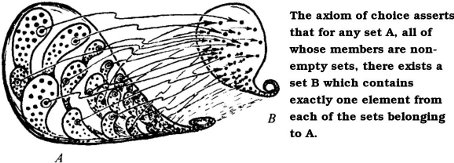
Upon discussing this bit of hilarity with my friends, we almost immediately jumped to the conclusion that ZFA set theory must be pro-abortion because of the (highly contentious) Axiom of Choice. This must be what separates the Democratic mathematicians from the Republican ones. It’s not all that nonsense about the Banach-Tarski paradox, it’s about Abortion! I get it now!

P vs NP

Posted by Eric Hennigan
On December 4th, 2008 at 22:12

Permalink | Trackback | Links In |

Leave a Comment |
Posted in Comp*, Ideas, Math

We’ve reached the NP-completeness section of my Fundamental Algorithms class, and I’ve noticed something interesting about P and NP.

class P NP-complete
Euler tour Hamiltonian Cycle
2-SAT 3-SAT
Shortest path Longest simple path

We have problems from a variety of different fields, for which one instance of the problem is in class P and the other is NP-Complete. I conjecture that whatever property it is that separates one class from the other, it must show up in all such fields. So the underlying fundamental reason for separating P from NP must translate from graph theory to boolean logic theory. It would be nice to gather such example divisions and then try to formulate an isomorphisms between fields. I’d think that eventually an isomorphism will be found that sheds enough light on the P vs NP problem that it can finally be cracked.

What really got me interested in this problem was noticing that Hamiltonian Cycle would be very easy to solve if we could convert it into an Euler tour by constructing an interchange graph; where all the nodes become edges and all the edges become nodes. But interchange is not a well defined operation on graphs, indeed it isn’t even possible in some cases. Example: The graph of 5 nodes and 0 edges. The interchange would have 0 nodes and 5 edges, which isn’t a graph. So, I was wildly speculating that perhaps what separates P from NP are these impossible operations. But to shed some light on the situation, I’d first want to construct a reduction of Euler tour from 2-SAT which mirrors the reduction of Hamiltonian cycle from 3-SAT.

Probability Programming

Posted by Eric Hennigan
On November 15th, 2008 at 20:11

Permalink | Trackback | Links In |

Leave a Comment |
Posted in Comp*, Language, Math, People

Yesterday a very interesting speaker, Eric Hehner, gave a talk at the graduate seminar:

TITLE

A Probability Perspective

ABSTRACT

This talk could be called “probability meets programming”. It draws together four perspectives that contribute to a new understanding of probability and solving problems involving probability. The first is the Subjective Bayesian perspective that probability is affected by ones knowledge, and that it is updated as ones knowledge changes. The problem of assigning prior probabilities is mitigated by the Information Theory perspective, which equates probability with information. The main point of the talk is that the formal perspective (formalize, calculate, unformalize) is beneficial to solving probability problems. And finally, the programmer’s perspective provides us with a suitable formalism.

I found the talk extremely fascinating. He first compared measures of probability, entropy, and information, demonstrating that they were (in a sense) substitutable concepts (analogous with Energy and Mass, or Energy and Temperature).

b bits = 2b states = 2-b chance
log(s) bits = s states = 1/s states
-log(c) bits = 1/c states = c chance

He also waxed poetical about how we are often fooled about probabilities, so it pays considerably to mechanize our calculations regarding those probabilities. It helps even further if we have a formal language into which we can directly translate our real-life word problems, so that we don’t accidentally setup and then solve the wrong problem. That is, we can then move on from debating about interpretations of the problem, and into actual calculation.

  • If I have two children and one of them is a girl, what is the probability the other is also a girl? (ans: 1/3)
  • If I have two children and the older one is a girl, what is the probability that the younger is also a girl? (ans: 1/2)

He also talked quite a bit on the Bayesian approach to probability, and why it is much nicer than the frequentist approach, because it assumes much less about the world. There is no need for a prior, and your measured probabilities are updated naturally as your knowledge of the world changes.

From this he moved on to providing a proto-language approach to how one would setup and solve these sorts of problems. He co-opted existing computer language constructs to do this. First we notice that in statements like

IF cond THEN this ELSE that ENDIF

the cond is a boolean value. But there’s a priori no reason why we are prevented from interpreting it as a probability, a real value in the range [0,1].

IF 1/2 THEN print(”heads”) ELSE print(”tails”) ENDIF

He quite nicely demonstrated a calculus that gives you the ability to compute the result of such random decision trees. So, for example if you were faced with the Two Envelopes Problem how you could compute the value of a strategy expressed in his probability language.

I really liked the talk because of the way in which it drew upon existing fields and showed a very curious intersection of them. After the talk I asked if he could use this language to calculate an optimum strategy (he said no, he hadn’t done that, but it would be a good area of research) and if he had considered the addition of a switch-case statement (he had, but though he didn’t know how it would look in the language, he quite liked the idea of adding it).

The research paper, a Probability Perspective underlying his talk is available, as is his book, A Practicle Theory of Programming. He also mentioned that he has a grad student that has applied this probability programming to proof of quantum algorithms with much success, and that he’s yet to find a student to implement (write a compiler/interpreter for the language)

Hallucinated Abstract

Posted by Eric Hennigan
On July 28th, 2008 at 13:07

Permalink | Trackback | Links In |

Comments (4) |
Posted in Comp*, Ideas, Math

I actually thought this up around sometime in Feb 2007; I had been reading Sipser’s Intro to Computer Science text, and hallucinated the following abstract while drifting off to sleep:

This paper presents an isomorphism between the set of problems in P and the Natural Numbers, and an isomorphism between the set of problem in NP and the reals. Using this isomorphism the properties of the equivalent classes P and NP are investigated. A property is found which holds for one class but not the other, thus P != NP. The isomorphisms are then used to prove that the Continuum Hypothesis is false because of the relationship between P and NP.

It’s pretty likely that this approach would have a fundamental flaw, but if so, I don’t have enough background to know what it is. Hopefully, I will be able to gain insight on the problem while here at University. Specifically, I’ll begin with the question: What is the cardinality of P?

Dymaxion mapping.

Posted by Eric Hennigan
On May 21st, 2008 at 13:05

Permalink | Trackback | Links In |

Leave a Comment |
Posted in Literature, Math, People

Ok, so I’ve been away awhile. I visited the Maker Faire, and San Deigo Amphib Base (twice). Two days ago I read Benford’s Cosm, start to finish. And learned that the nucleus of heavier elements are ellipsoidal rather than spherical. Anyway, while I wait on preparing back-date posts of the aforementioned activities, I found out some interesting stuff today.

I was reading Geodesic Discrete Global Grid Systems (Kevin Sahr, Denis White, and A. Jon Kimerling. 2003. CaGIS 30(2): 121-134). I went out to search for code that does a grid <--> lat/lon conversion for Fuller’s Dymaxion icosahedron. Gray, R.W. actually wrote such code, for a flattened (2d) layout of the icosahedron, which might be useful in the future. These searches led me far afield, to the wikipedia article on Buckminister Fuller himself, where I leared that he was much better about recording events in his life than I am in mine. In fact,

Fuller documented his life every 15 minutes from 1915 to 1983, leaving 80 meters (270 feet) of journals. He called this the Dymaxion Chronofile. That is said to be the most documented human life in history.

And he also had lots of fun playing with words, and argued, quite rightly, that certain words impede clear thinking:

The words ‘down’ and ‘up,’ according to Fuller, are awkward in that they refer to a planar concept of direction inconsistent with human experience. The words ‘in’ and ‘out’ should be used instead, he argued, because they better describe an object’s relation to a gravitational center, the Earth. ‘World-around’ is a term coined by Fuller to replace worldwide. The general belief in a flat Earth died out in the Middle Ages, so using wide is an anachronism when referring to the surface of the Earth — a spheroidal surface has area and encloses a volume, but has no width. Fuller held that unthinking use of obsolete scientific ideas detracts from and misleads intuition. The terms sunsight and sunclipse are other neologisms.

What an awesome dude.


Finally, I should make note of some articles that I wasn’t able to find online, but that I think would be good to read later.

  • Gray, R. W. 1995. Exact transformation equations for Fuller’s word map. Cartographica 32(3): 17-25.
  • Gray, R. W. 1994. Fuller’s Dymaxion Map. Cartography and Geographic Information Science 21(4): 243-246.
  • Snyder, J. P. 1992. An equal-area map projection for polyhedral globes. Cartographica 29(1): 10-21.

The half-derivative

Posted by Eric Hennigan
On April 13th, 2008 at 19:04

Permalink | Trackback | Links In |

Leave a Comment |
Posted in Education, Ideas, Math, Self

When I was in college, I once had this crazy notion of a half-derivative. We’d been taking nth-derivatives in physics, and I wondered “why stick to integers?”. Well, as it turned out, others had been there before me. At the time it looked like complete non-sense, and even now, if I had to start from scratch, I doubt I’d be able to generate a formal and operational definition from which you could actually calculate the thing. Last weekend I mentioned this this to my dad’s buddy Captain Smiley during my trip to San Diego for his change of command ceremony.

Also, during that trip I visited Wahrenbrocks Book House (a delightful 3 story used book store (that smells great!) with little piles of books on the old wooden staircase), and purchased a whole box of books (cost $180). Among the many books I purchased was Feynman’s Rainbow, which had this funny tale:

Feynman is answering Mlodinow’s question “Is it foolish to become mature?”

I’m not sure. But an important part of the creative process is play. At least for some scientists. It is hard to maintain as you get older. You get less playful. But you shouldn’t, of course.

I have a large number of entertaining mathematical type of problems, little worlds of this kind that I play in and that I work in from time to time. For example, I first heard about calculus when I was in high school and I saw the formula for the derivative of a function. And the second derivative, and the third… Then I noticed a pattern that worked for the nth derivative, no matter what the integer n was — one, two, three, and so forth.

But then I asked, what about a “half” derivative? I wanted an operation that when you do it to a function gives you a new function, and if you do it twice you get the ordinary first derivative of the function. Do you know that operation? I invented it when I was in high school. But I didn’t know how to calculate it in those days. I was only in high school, so I could only define it. I couldn’t compute anything. And I didn’t know how to do anything to check it or anything. I just defined it. Only later, when I was in the university, did I start over again. And I had a lot of fun with it. And found out that my original definition that I thought up in high school was right. It would work.

Then when I was in Los Alamos working on the atomic bomb, I saw some people doing a complicated equation. And I realized that the form they had corresponded to my half derivative. Well, I had invented a numerical operation for solving it, so I did it, and it worked. We checked it by doing it twice, which is just the ordinary derivative. So I did a nifty numerical method for solving their equation. Everything, well, not everything, but lots of fun stuff turns out to be useful. You just play it out.

So, alright, I’m no Feynman. Though I remember considering nth derivatives in high school (during my calculus class), I never actually performed them until we did it during physics class in college. And it was only then that I thought of the “half” derivative in the same definitional sense that Feynman did when he was in high school. I was never actually (still do not consider myself) capable of independently coming up with a useful operational definition that can actually be calculated.

Weekly Summary of Noospheric Echolocutions

Posted by Eric Hennigan
On February 29th, 2008 at 12:02

Permalink | Trackback | Links In |

Comments (1) |
Posted in Comp*, Economics, Ideas, Language, Math, Philosophy, Tech*

This past week I finished my reading of Mandelbrot’s most recent book The (Mis)Behavior of Markets. I actually didn’t like it that much. I found the book to be especially light on details; for a mathematical empiricist Mandelbrot didn’t actually explain, in unambiguous terms, the patterns that he sees in market data. He did a good job of showing that price charts appear roughly the same independent of company and time-interval. (That is, if you forget to label your axes then a chart covering a few years doesn’t look appreciably different from a chart covering only a few seconds.) But the details of how he knows about the multi-fractal patterns, and how to measure such patterns, or even the basic mathematical characteristics of mult-fractals went entirely ignored. Some of these details were given in a reference appendix for each chapter, but not nearly enough to satisfy my avid mind. The editor also did a poor job of citing Mandelbrot’s references to peer-reviewed papers throughout the text; you had to simply follow along in the appendix simultaneously while reading the main text (an annoying usability bug). Instead of discussing such details within the main text, he opted to give generalized overviews with inadequate pictures of fractals that have nothing to do with finance. Now, I know that since I read graduate-level textbooks on Computer Science in my spare time, I’m not the target audience for this book, but I would have expected to see many, many more price charts and elucidating discussion of features within such charts, esp. considering that he’s so big on empirical data. As it was, even when the book had pictures to convey the geometric ideas within the text they came out piss-poor and confusing. Tufte would be appalled.

Mandelbrot also seems to have a healthy dose of self-assurance (deservedly so, for he is quite accomplished). He didn’t fail to mention that one of his students (Fama) formulated the Efficient Market Hypothesis, and that his early paper on cotton prices help to form a pillar of econophysics. He certainly deserves recognition for developing a very important part of mathematics, but I consider his abilities to write for the layperson to be severely lacking.

I’ve also been reading up on Component-Oriented Software Construction. It’s not a panacea that will solve all the industries woes, but I consider it a significant step towards solving many of our current problems. The traditional Object-Oriented inheritance paradigm is fundamentally incompatible with parallelism, and OO in general suffers from systemic rot as shown by the Circle-Ellipse Problem and the Fragile Base Class Problem. The move toward a Component-Oriented architecture is, in my opinion, a beneficial one. But it comes at a high cost; instead of having a (complex and rigid) framework for message passing and method calling, the programmer must handle request forwarding and chaining themselves; functionality is derived through composition instead of inheritance. In my experience, programmers are the most unreliable piece in the software construction business, and relying on humans to successfully adapt their minds (already trained on the OO model) to a new methodology is a mistake. Furthermore, the Component-Oriented message passing system is so flexible (best formulated as a general directed graph) that a programmer could easily get themselves into the opposite of a deadlock (messages getting passed around continuously in a Hamiltonian path). Debugging could be a real nightmare in such a system, and we’d really best develop techniques for tracing and visualizing information flow throughout the program.

I watched a recording of Guy Steele’s infamous lecture Growing a Language (because of the poor video quality, you really want to read the article as you watch), which he gave at OOPSLA ‘98. This was a delightfully instructive video, I recommend that everyone interested in programming language watch it. I also watched a presentation he gave about his newest language, Fortress, because it was mentioned at LtU. I especially like the mathematical nature of the language, and his willingness to go back and try syntax experiments (APL, PL/I) that failed due to requirements of specialized hardware.

I also read Vannevar Bush’s famous article As we may think, wherein he introduces the memex. I found the proposed interface to the memex to be both antiquated and mechanically cumbersome, when compared to the modern computer. But, given the technology in his day this is to be expected. Some of the issues related to search, recall, and annotation, were unfortunately glossed over; in fact, these same issues still plague us today, everybody consistently underestimates the complexity of the task; reliable associative search is a hard problem. He did have the remarkable foresight to envision how people would wish to use such a system, and, were he alive today, would probably be greatly enamored with the collaborative efforts of knowledge sharing that places such as wikipedia represent.

CS and Game Theory

Posted by Eric Hennigan
On July 25th, 2007 at 20:07

Permalink | Trackback | Links In |

Leave a Comment |
Posted in Comp*, Ideas, Math, Tech*

I read Papadimitriou’s article on Algorithms, Games, and the Internet, and found it to be a rather nice overview strongly hinting at future emphasis within the Theoretical Computer Science community. I’ve long thought that a good game theoretic background would help in the development of network protocols, esp. wireless protocols. I particularly liked FON’s original approach (Bills, Linus’s, and Aliens) to popularizing the spread of wifi.

I also really liked section 6, Mechanism Design, where he says that:

If an artifact (a new congestion control protocol, a new caching scheme, a new routing algorithm, etc.) is demonstrated to have superior performance, this does not necessarily mean that it will be successful. For the artifact to be “fit,” there must exist a path leading from the present situation to its prevalence.

A formalization of this observation could really help out those in Software Software Engineering.

All in all I’d like to see the development of a Universal Protocol that lets all devices communicate in a wireless fashion. So that I can buy a TV, Computer, Equalizer, and Speakers all separately, and by simply having them in the same room, I can pipe video from Computer to TV, audio from Computer to Speakers, or from TV to Equalizer and then Equalizer to Speakers. A single protocol should be able to carry everything from audio to video to any device that publicly announces a stream or slot. Internet traffic should be similarly transparent. With the correct allocation algorithms, we can build a nation-wide wireless aethernet one $40 router at a time. (Even better if we could work in roaming.) And it’ll all come from a coupling of Game Theory and Computer Science.

The Rules of Logic

Posted by Eric Hennigan
On June 10th, 2007 at 12:06

Permalink | Trackback | Links In |

Leave a Comment |
Posted in Idiocracy, Math

Taken from Scott Aaronson’s PHYS771 Quantum Computing Since Democritus


  • Propositional Tautologies: A or not A, not(A and not A), etc. are valid.
  • Modus Ponens: If A is valid and A implies B is valid then B is valid.
  • Equality Rules: x=x, x=y implies y=x, x=y and y=z implies x=z, and x=y implies f(x)=f(y) are all valid.
  • Change of Variables: Changing variable names leaves a statement valid.
  • Quantifier Elimination: If For all x, A(x) is valid, then A(y) is valid for any y.
  • Quantifier Addition: If A(y) is valid where y is an unrestricted variable, then For all x, A(x) is valid.
  • Quantifier Rules: If Not(For all x, A(x)) is valid, then There exists an x such that Not(A(x)) is valid. Etc.


Simple rules, I wonder why so much of the world seems to have such problems. I must be because the ways of logical fallacy are more numerous than those of correct deduction.