eric the fruitbatBlog
Sounding out the Noosphere.

Posts from February, 2009

Dan Barker and Jesus

Posted by Eric Hennigan
On February 24th, 2009 at 17:02

Permalink | Trackback | Links In |

Comments (10) |
Posted in Religion, Self

Last night, I attended another talk with Dan Barker, at Saddleback College; this time about the historical person of Jesus Christ, hosted by the free thinkers club. Again, this is a brief transcription covering all the major points of his talk.

  • Compliments the club for being an activist group.
  • Mentions that he loves to travel to such groups all over the country. They are part of a movement, but one with no followers. It’s composed of free-thinking, skeptical, individuals.
  • The growth of these groups is a sign that the country is becoming more secular. The country is growing up, changing. The 20-somethings age group is the most secular demographic. 25% areligious.
  • Plugs the Freedom from Religion Foundation.
  • Anecdote about how the christians in some grade/middle schools are a minority. Classmates whisper about the religious in disbelief that anyone would waste time by going to church.
  • Plugs book, Godless. It’s an updated version of his previous book, and tells his conversion story.
  • Here to talk about Jesus: History or Myth.
  • Has a whole chapter about this in his book.
  • When he was a preacher he loved and knew Jesus, felt he was real. Christianity is a relationship with Jesus.
  • After he became atheist, and started studying Jesus, he realized how powerful that relationship is, and how fraudulent.
  • C.S. Lewis in Mere Christianity came up with a famous tri-lemma. Jesus is either a liar, lunatic, or Lord.
  • What do these options have in common? Assumes that the story is true, that the text is accurate. So we can add another L: Legend. If Jesus is a legend or literary embellishment, then it’s irrelevant to ask Liar, Lunatic, Lord.
  • There’s also a fifth option: Myth.
  • Skeptics don’t actually agree on whether Jesus actually existed or not. But Barker’s position leans towards myth.
  • There may have been a similar person, Jesusha. There are also stories of others Messiahs during that time. (Egyptian, etc..)
  • Even Christian scholars think that the story in the New Testament is legendary. They have a distinction between the Jesus of history and the Jesus of the New Testament.
  • Example of such a figure would be William Tell. There may have been such a person, but that doesn’t support the legendary figure. There are also other modern examples of legendary growth. And it happens fast, within days. (Healers make the news in India and Mexico for example).
  • There’s also a group that thinks Jesus as a person didn’t exist. The position of the Mythicists.
  • But It could actually be both.
  • Reasons to doubt the historical Jesus: There is no historical confirmation outside of biblical literature.
  • If the story is true, he would have been born 1-4 AD, and died around 30AD. Mathew, Mark, Luke and John pick up writing about him at 70AD to 90AD. So were talking about a 2nd or 3rd generation of believers. [I argued this point with my apartment mate afterwards, it is possible that these guys were alive and walked around with Jesus; but I'd say, actuarially, they'd have to have both younger than Jesus, and have lived twice as old as the average age at that time. I think it's pretty improbable, nevertheless it remains possible.]
  • We have no first hand accounts. Jesus never wrote anything.
  • Paul’s epistles are the earliest account. written around 50-55 AD.
  • We notice that Paul has a very curious silence about historical Jesus. He never mentions a single deed or miracle, never quotes Jesus. Most of the time he refers to this christ-like figure. He never claimed to have met Jesus. (anyway, he was blind after being knocked off his horse.) Talks about Jesus as part of spiritual experience. Though he does mention the formula of the Last Supper, and Resurrection; but these are a formulaic account.
  • Among other writers (outside the Bible), nobody has stories about Jesus. But there are accounts of other messiahs.
  • Christian apologists have a long list of witnesses. But the entire list is second-hand at best. It is possible for a religion to get off the ground without a historical Jesus (Mormonism got off without a real angel Moroni.)
  • There were early sects of christians that worshiped Christ as a God, but not as a person.
  • The writing of Josephus: He wrote a huge book, and right in the middle of a list of calamities, there’s a small paragraph. He writes:

    Now there was about this time Jesus, a wise man, if it be lawful to call him a man, for he was a doer of wonderful works, a teacher of such men as receive the truth with pleasure. He drew over to him both many of the Jews, and many of the Gentiles. He was the Christ, and when Pilate, at the suggestion of the principal men among us, had condemned him to the cross, those that loved him at the first did not forsake him; for he appeared to them alive again the third day; as the divine prophets had foretold these and ten thousand other wonderful things concerning him. And the tribe of Christians so named from him are not extinct at this day. (Jewish Antiquities 18.3.3)

    But everyone thinks this paragraph has been inserted. There’s no quote of it until after 4th century. The language is later than the rest of the book, and since Josephus was an orthodox Jew, would never have written this without further elaboration. In another section (Jewish Antiquities 20.9.1) There’s also a reference to James, the brother of Jesus, which is also probably a tampering.

  • Even the apologists that admit such, are admitting that Christianity has a history of tampering.
  • Another reason to doubt: The actual claims are contradictory: The Birth of Jesus, and the Nativity Scene (and Bill O’Reilly’s War on Christmas). Many claim this is a historical event (to support its display in public sphere). But Matthew writes that “Now when Jesus was born in Bethlehem of Judea in the days of Herod the king, behold, there came wise men from the east to Jerusalem,” (Mat 2:1) But we know, from independent sources that King Herod died in 4 B.C. Then, Luke tells a different story, Jesus is born during a Census in Syria. “This was the first registration taken while Quirinius was governor of Syria.” (Luke 2:2) But Syria wasn’t part of Roman Empire until 6 A.D. So, either Jesus was born 9 years premature, or a few years late. At the very least, there’s an uncertainty/inconsistency
  • There is also a discrepancy in Jesus’ genealogy. Some authors trace it back to Adam, but with only 42 generations.
  • Matthew is the most sloppy, has exactly 3 sections of 14 persons. It was probably done this way for numerical aesthetics, and it contradicts the Old Testament (he left out some names).
  • Christian apologists dodge: The argue that Luke presents a genealogy through the father, while Matthew traces through the mother. But the two lists contain common names! So they contradict each other.
  • We can also see that the story of Jesus can be explained in natural terms, without his ever having had existed.
  • We don’t see anything unique, many heroes were born of a virgin. Augustus Caesar ascended into heaven at Death. There are also many parallels with other figures: ex, Mithra, Raglan’s Hero pattern
  • Early christians such as Justin Martyr argued:

    And when we say also that the Word, who is the first-born of God, was produced without sexual union, and that He, Jesus Christ, our Teacher, was crucified. and rose again, and ascended into heaven, we propound nothing different from what you believe regarding those whom you esteem sons of Jupiter. (First Apology, chapter 21 “Analogies to the history of Christ”)

    When trying to convert others. So, even back then the mythological similarities were known. Thus, modern claims that is something especially different between Christianity and Paganism, are baseless.

  • So if these guys couldn’t say that anything was different, and yet they were much closer to the events. How can we moderns be blamed for coming to the same conclusions?
  • The naturalistic explanations don’t actually have to be proved. Only demonstrating plausibility is enough. There’s no reason to jump to Supernaturalism. We know that Humans are fallible, that we are eager to accept fancy, myths, legends, exaggerations, etc… We don’t know that snakes can talk, or that people can ascend into heaven, or be resurrected, or walk on water, etc.. So if we go with probability, it’s much more likely that the story was fabricated than that the laws of Nature/Physics were violated.
  • To Christians the Jesus of the New Testament is Jesus. Yet we can demonstrate this figure to be legendary. Picture Jesus’ life and the mark points on the timeline where the writers (Paul, Matthew, Mark, Luke, John, etc.) record their tales. Look at the mystical element of the story, the miracles. We find that the earlier accounts have fewer extraordinary events. The miracles don’t appear until later writers record the account. You can actually track the legendary growth through history. Because of this, it’s irresponsible to treat the book as flat, as accounts written at the same time. But that’s how most christians view it.
  • Dan’s position is that Jesus is myth. But you can’t really prove that Jesus (the person) never actually existed. Similar argument to proving the non-existence of Leprechauns. But the probability of a historical Jesus is low.
  • Since there’s no outside confirmation, and Paul is silent about witnessing Jesus, and there are internal contradictions of the account, and there are natural explanations, and history must assume continuity over time (in accordance with natural/physical law), It is safe to conclude, with high confidence, that Jesus of the New Testament did not exist and is myth or legend.

After the talk there was a Q+A:

  • Can you say something about the plethora of non-canonical gospels. There’s this tale from Peter, which is kinda weird. It involves lion heads, talking cross, etc. There’s also Thomas, Hebrews, Judas, etc. It wasn’t until the 4th century that Constantine had to codify the theology (and destroyed the blasphemous literature afterward). Even the Christians that think God inspired the Cannon, have to admit that there were Christians early on that were in the habit of making up stories and passing them off as truth. Even the catholic church shows tampering with the Latin. The presence of these accounts, and their varied nature, shatters our confidence in Christianity as something other than mythology.
  • What event converted you? The first time received this question he was on the Oprah Winfrey show. It was a gradual process, over 5 years. There was no bitterness, it was the motiviation to know the Truth and speak it, that drove him both to and from Christianity. He holds knowledge of truth above having faith, or feeling good.
  • As an atheist do you have any positive beliefs? Some atheists may have some beliefs. But atheism itself is a denial of God. The nature of belief is to weaken the thing it talks about. It’s a qualifier, that states you don’t have absolute knowledge. Atheists can hold beliefs, but do so with the knowledge that they can be proved wrong with the right evidence.
  • Do you think that many religions in the world are…. Why are people so willing to be religious? In his book he presents two hypothesis, one that describes the origion of religous belief from an Evolutionary perspective. Uses an example with a stick being mistaken as a snake. Those who assume the more cautious way live, while those that assume the other way, died. We also have, a hyperactive agency detector, such a mechanism is good for survival. We read bumps-in-the-night, shadows, etc. as the worst, as monsters, attackers, etc. We also evolved two contradictory features, small pelvis and large brain. As a consequence we have a prolonged mental development. An infant requires at least a year of complete dependance on parental care. We have a built-in obedience. Religion is a kind of retarded development, where we project the father figure into the sky. Combining these two things, it makes sense that we would assume an agency exists, and wish to worship it. But avoiding the naturalistic fallacy, these instincts (violence, xenophobia, etc.) aren’t necessarily good.
  • What happens when your confidence clashes with the confidence of others? This is why we have laws, to prevent outrageous actions of true believers. We can appeal to moral law, and the minimization of harm. Most of us are naturally good, though there is a distribution. Murders, etc, are “inhuman” things to do. We can objectively judge via this harm.
  • Does this give us the moral right to impose force to stop certain practices? In general yes, but we must minimize the force used. The state has a right to take parents away from abusive parents. We’re still figuring this balance out though, esp. when it comes to war. Sometimes, even
    with good intent, we get it wrong.
  • You seem to have a number of uncertainties. Why then call yourself an atheist rather than an agnostic. He knows that there is no Christian God of the Bible. Knows about the historical uncertainty of the tale, about how mythology arises, fallibility of humans, etc. This gives him enough of a confidence to assert there is no God (of the Bible, which is what everyone refers to with the term).
  • Observation that one of the factors explaining why religion is so widespread is because governments use them to keep people in line. Yes, especially in our early history. You’d worship your dictator. The posture of prayer is one of servility, knees bent, hands bound together, etc. There is a part of us that wants to please the King, and be protected by him.
  • Before becoming atheist, did you look at other religions? Yes and no. He had to climb out of the hole of Christianity, so that was the primary focus. Briefly he looked at some other religions, and saw the same arguments. Saw the generality of religion. But doesn’t have the time to completely analyze all the religions. Christians know that the Koran isn’t true without having ever read it, likewise most atheists don’t have to read too much into the Bible to reject it.
  • What about gaining expertise? Christians require that atheists know completely the details of the Good Book, and it’s history. They argue “If you could only just read it in it’s original, with the right interpretation.” This is hypocritical, the believers aren’t required similar knowledge to assert its Truth.
  • What about your lawsuits? It’s not that we’re trying to assert atheism into government, but neutrality. Many christians don’t really understand the difference, and confuse neutrality with hostility. Example: money. Many christians say that “In God we Trust” is such a small thing, that it
    doesn’t matter. Response: Then you won’t miss it when it’s gone!
  • How do you define the difference between atheism and agnosticism? Atheists and philosophers aren’t in agreement about this. But, in general, most define atheism as a lack in the belief of God. It doesn’t mean anti- it just means lacking. In this sense every baby is born an atheist. But, there is a set of positive atheists, that believe there is no God. And this meaning is the popular one. Agnosticism is totally different, it deals with knowledge. So he would call himself an Agnostic Atheist.
  • What about a gene that promotes belief? Is it fair that someone must go to hell because he didn’t get the gene? There is truth to what you say about the variation in the human population. But Barker falls into one of the tails of the Bell curve, he can have mystical experiences, talk in tongues, goosebumps, feel the spirit, etc. The religious experience is very real, but it doesn’t
    point to anything outside the brain. And what kind of God would design some people so that they can’t feel his presence, and then punish them for not believing?
  • What about the God Helmet? We’re getting to a point in psychology where these things can be explained mechanistically. I hadn’t heard about the helmet, I want to do it! If you had come to me 20 years ago, I wouldn’t have been convinced. I would feel pity that someone else couldn’t have such a close feeling relationship with Jesus.
  • Can you blame the fundamentalists, if nobody is in charge of their brain? Yes, you can judge their actions. They can think whatever they like, but we must stop the actions that cause harm. A moral person has an obligation to at least denounce it, if not intervene to stop the harm.
  • Can you articulate how people come by their morality? The first point to make is that no christian has the correct side of any social debate. You find christians on both sides (birth control, stem cells, homosexual rights, abortion, etc.). On the other hand, those of us that don’t have rules, but have principals instead, we are all acting to minimize harm. There is also a basic reciprocal altruism that is instinctual.
  • Why would we have a moral character, if it’s not strictly necessary for survival. Most mothers have a fierce protection instinct for their offspring. This is true of all species. You also care about the ones next door, but not to the same extent. The further you go genetically, the less natural is the motive. There is an advantage to protect those of your own species. As social animals, these instincts are particularly strong.
  • Christians don’t have a code of morality, more of a code of obedience. They follow what the precepts are today. If god said to kill your child you would, regardless of the morality. Yeah, but this only applies to the extremists. 90% of catholics disagree with the pope on birth control. Some people would go through with the immoral act (killing atheist Dan Barker) if God told the to do so. This lack of individual thinking is dangerous for society.
  • How do you respond to the crimes (Russia and China) of the crimes committed in the name of Humanistic Atheism? There are some bad atheists, but they didn’t kill because of their atheism. There are also some bad christians. But the way to truth is not to do a body count, if both belief systems have a stack of bodies, they both fall, they are both discredited.
  • What about the friends to whom you wrote a letter about your atheism? This is a good way to tell you true friends. Some people are just good and nice in spite of their belief system. His family was a good loving, close family, and most members eventually came around to his atheism.
  • Thank you for saying what everyone thinks. Isn’t morality culture-based? There is a difference between morality and ethics. Some people subscribe to moral relativism, that an action can be judged differently in different cultures. Most atheists/agnostics would subscribe to ethical relativism, that some action can be judged differently based on the context in which it happened, as it would adhere to moral principals. Most atheists/agnostics would say absolute morality is dangerous, that each action must be evaluated in context. We have principals, not rules, we can judge both each other and other cultures, based on these principals.

Dan Barker, Godless

Posted by Eric Hennigan
On February 20th, 2009 at 10:02

Permalink | Trackback | Links In |

Comments (1) |
Posted in People, Religion

Tonight I attended a nice speech, Q+A, and Booksigning given by the President of the Freedom from Religion Foundation, Dan Barker. His talk was basically the same as one that can be found elsewhere online, but I took notes anyway. Most of the stuff that he talks about is contained in his book, Godless: How an Evangelical Preacher Became One of America’s Leading Atheists.

  • The fastest growing religion in America is Non-religion. The number of checkmarks in that box has risen rapidly, more than doubled in recent years.
  • Atheist and non-believer groups are growing. They are sprouting up like mushrooms, and no single organization is behind it. This is good, it means that people are waking up, and questioning.
  • Suddenly there’s been this new market for Atheist literature. It used to be that a publisher wouldn’t touch the stuff, now a few are actively seeking it. Some bookstores have it as a whole section
  • Mentioned his book, and some nice blurbs. Thought that there should be something like an anti-blurb. Ex. Hannity or Bill O’Reilly saying “Do not read this book. It will corrupt the soul of America.
  • Shared a piece of the forward written by Richard Dawkins. It’s about the weirdest compliment he’s ever received.
  • Unlike Hitchens and Dawkins who were never really believers, His book is about an actual conversion, and explains what goes on in the mind of a True Believer.
  • As a believer, He was convinced that it was the end times. That his obligation was to preach the word to all of God’s children. He was chosen, at the right time, in the right city, in the right country, to be a soldier for God. He preached in the streets, and it was your lucky day to sit next to him on the bus (though you might not have known it).
  • Mentions that crude proselytizing works! You look at a person and say “I can tell you’re having real struggles. That you’re having a problem with a personal relationship.” The listener will be uncertain, and since the preacher is smiling and confident, people lay down their guard and give men of God automatic respect.
  • As a minister, he was seeing miracles, Pentecostal hand healing, Living in God’s light.
  • Churches love to put up the animated youngsters, it gets everyone excited, attracts more believer.
  • Anecdote: He had a friend, that was called on to preach. But had lost his voice right before it was his turn. They huddled, he reasoned that the Bible says believer will be healed, not maybe, not eventually but here and now, so he exclaimed “By the power of Jesus, I heal your voice.” His friend was suddenly able to talk, and gave his sermon. Now he knows this type of thing to be confirmation bias. It would be a true miracle if prayers were never ever answered. Rather when they aren’t it’s not remembered or the memory is transferred, God’s teaching me a lesson about patience. Much later, he was told by a doctor that sometimes when people are nervous, their vocal cords and throat can become restricted, and they loose their voice. This might have been the case.
  • As minister, he was really trusting his whole life in the hands of the Lord. He had no savings, no plans for the future, and lived from day-to-day, always hoping that collected donations at the end of his sermons could get him to the next preaching. He really believed that it was the end times, and that God would provide.
  • He eventually got into doing christian music. Did an album. Mary had a Little Lamb. Which, theologically, refers to the virgin Mary giving birth to the Lamb of God. This developed into a nice career, and he started doing music events and record production.
  • Not all of these events matched his belief system. He was a Biblical Literalist. Jesus said (Rev. 3:16) “But since you are lukewarm and not hot or cold, I’m going to spit you out of my mouth.” Things are really black and white in the mind of a Fundie. None of this metaphor stuff.
  • But since the people he met were mostly really nice people, his theology started to shift. He reasoned that a difference of opinion (Adam and Eve being historically real vs an Israelite parable) shouldn’t divide the community. Even though he was shocked by this grayness.
  • Eventually, in his deconversion, he realized that there are probably as many different types of Christianity as there are Christians.
  • Paul said “God is not the author of confusion.” Yet can you think of any other book that has caused more confusion?
  • As a travelling evangelist, the people he met were nice and caring. They weren’t evil, yet they also didn’t believe exactly as he did. He met enough people that eventually his brain started working. Like the environment of a Liberal University, the diversity got him thinking.
  • The frontal lobes of the brain are the last to fixate their wiring, especially for men. He suddenly experienced a hunger for knowledge, rather than feelings. His brain felt starved, he started questioning, reading, learning, science, philosophy, evolution, humanism, liberal christianity, completely other points of view and theologies.
  • His sermons migrated from preachings about Hell and the afterlife to Love and the good that should be done in this life.
  • But Jesus never came down from the heavens.
  • He learned that in every generation, even at the time of Jesus, there was a subset that believed it was the end-times. Paul thought this. (a few digs at Jehovah’s Witness’s for repeatedly giving dates) But it never happened. He realized that it was never gonna happen.
  • Anecdote, about seeing a sign in one of the churches, near the rafters. Cobwebs in the corner, paint peeling. It says “Jesus Coming Soon.”
  • He can still speak in tongues. Reasons that the susceptibility to mysticism is a natural part of being human, that there’s probably a bell curve. That the feelings are a function of the brain. Dopamine, love-making, laughing, chocolate, enjoyment is about the brain. Coupled with a belief system this allows people a false, but no less powerful, confirmation.
  • If anyone was a True Believe he was. He felt it, it was never fake, it was all real experience, but realizes now that it wasn’t the gift of a superpower.
  • He converted to Atheism all by himself. There wasn’t an atheist evangelist on TV, nor a visitor at his door. It was all by his own reasoning.
  • If the prodigal son was a parable, and Adam and Even a metaphor, then maybe God himself was a figure of speech? Where do you draw the line? What parts do you choose to be literal vs. metaphor? Where’s the evidence?
  • So he looked at the different denominations, what all the different religions had to say, what science had to say. He never intended to reject his beliefs, but wanted to find truth, and had a real hunger for knowledge.
  • He experienced a voice in his head: “somethings wrong with the way you think.” It wasn’t the Holy Ghost, but the voice of Reason, and it kept getting louder and louder.
  • Made a pact with himself about seeking Truth instead of God, following reason rather than feelings (faith). Would look at the evidence, even if it lead him away from God. It’s what he would want for a Muslim. For them to rise above their belief and culture.
  • The eyeball of objective rationality that the was using to parse the world suddenly got turned on him. He sought other reasons for stuff, and received no evidence for God.
  • Reasoned that if something must be taken of faith, then admitting such is demonstrating that it can’t be taken by evidence.
  • He dumped out the bathwater, and discovered that there was no baby. He was not convinced by any of the arguments (not the moral argument, argument by personal experience, ontological argument, argument by design, etc..)
  • Saw that there was no coherent definition of God, that there’s no solution to the problem of Evil, that there’s no coherent definition of morality. Just walk into any children’s hospital to see that there is no God. Why would these innocents be suffering, what are some spared while others are taken?
  • Realized that without God he could still lead a meaningful, moral, productive life.
  • At first he was a private atheist. It was his own freethinking that lead him this way, nobody else was responsible for coercing him.
  • Anecdote: He was alone in his chair looking at the stars, and it hit him. He was alone. Truly alone, there was no all-powerful observer with him. He was free. Saw the stars as natural bodies of gas consuming their elements, eventually dying out. Saw himself as a similar organism.
  • But he would still rather know truth, than fool himself into happiness.
  • He still had speaking engagements, so for 4 months, he was a real hypocrite. Giving sermons about a God he knew wasn’t there. One time, he had a woman come up to him and declare how she had felt the power of God in his sermon. His experience was completely different.
  • The last sermon/concert (at Christmastime) that he went to had a village atheist. Everyone in town really liked him, and were concerned that he wasn’t saved. During the event he wanted to just stop all the hypocrisy and come clean, out himself. But he didn’t, instead went through the performance as an act of showmanship. Afterwards there was a reception, where someone toasted “Isn’t it nice that we can all come together to celebrate the birth of our Lord.” The lone atheist interjected loudly: “Not all of us”, and Dan felt good.
  • He used to think it was tough being a christian in the world. Yet try being an atheist, a lone voice of reason that nobody wants to listen to.
  • He wrote and sent out a letter to his friends and family about his atheism. Writing it all out was a positive act (unlike praying). He received some nice letters from some friends, and some not-so-nice letters from people he thought were his friends.
  • He still had a couple christian songs to write, as he was under a contract. His employer, didn’t care that he was atheist, and still needed the songs. His craftsmanship was still good, and they were publish in the album Sonrise Island under the pseudonym Edwin Daniels. He still receives royalties.
  • His mom and dad eventually became atheist, which was unexpected. She had been a sunday school teacher, but flew out to talk about his new belief. When she got back, she never went into another church again. His dad took longer (2 years), as he was teaching seminary.
  • Realized that he didn’t have to hate anymore.
  • His youngest brother heard the news, and was “Me Too!”. But then he was never a hard-core christian anyhow. He thinks there are many people like this, that harbor internal doubts but that would give up their pretending if they had an example to lead them.

After the talk there was a Q+A session. A number of people asked about specific court cases that the FFRF is handling, I didn’t record those.

  • Why didn’t you bring a guitar to have jam session? Well, he has some cd’s like Beware of Dogma.
  • What does your organization focus on? They work to keep church and state separate, and educate the public about the views of non-believers. They have full-time staff to challenge Bush’s faith-based initiative, and religious symbology used in government functions. There’s a lawsuit about God being mentioned in the Inauguration. They are also joined by many religious groups, and newspapers are editorally in favor of their actions. They run billboards and other ads to raise awareness.
  • Doesn’t going after a nativity scene encourage negative publicity? In Washinton state, the legislature was pressured into allowing a nativity scene that the governor had previously rejected as inappropriate for a government building (indeed, this broke tradition as there had never been one before). After that the atheists decided that they’d get a sign that used rather strong wording for the Winter Solstice. Then dozens of others wanted signs too! Pastafarians, Festivus, etc… It caused such an uproar, they’ll never make the mistake of allowing such a scene again.
  • Do you ever miss the certainty of Fundamentalism? He needed time to adjust, early on he had nostalgia. But ultimately, he doesn’t miss it. Thinks it’s really dangerous in some ways. The recognition of uncertainty is what drives science, he’s not denying religious experience.
  • Since the value of a story is usually discussed in human terms, should we promote the idea that religion is a part of the human experience? Well religious people often play this game of “Love the sinner, Hate the sin.” We can play that too. Sure there’s room for ridiculing, but it’s not an argument that’ll sway everyone.
  • Before you were proselytizing, now you give regular speeches. Are you still the same way on the Bus? He’s still the same kind of guy, but it’s really toned down alot. He’s more courteous, but still takes every opportunity. Once at an airport he bought some food that rang up $6.66, and exclaimed “That’s the perfect number for an atheist.” The person behind him shared the amusement. Just as with the gay movement, the more people that are out, the easier it’ll be for everyone.
  • Are you absolutely certain there is no God? Well, philosophically no. He can’t be. He’s not absolutely certain there are no Leprechauns, they could be hiding. But he is certain that the personal God of the bible doesn’t exist. It has too many qualifiers and is logically inconsistent. As for the more abstract notions, the confidence level achieved by lack of evidence is high enough that we round up and say “God does not exist.” But this is no more absolute than any other thing in science. It’s not out of commitment to a particular worldview, we’re not hiding from acknowledgment. It’s just it’s an extraordinary claim with no evidence.
  • Have your ethics changed at all? On balance no. Most christians are good moral people, in spite of the Bible. He is more concerned though about issues such as women’s rights, oppression of minorities, etc. Thinks that we should judge people by their actions rather than their beliefs. If a religious behavior is causing harm then we should intervene (in accordance with the severity of the harm).
  • Where do you draw the line on that?Morality is about minimizing harm. It’s not a system of rules that are blindly followed. It’s relative and contextual. For example stabbing a child with a big needle is wrong, unless it needs a life-saving injection. Though not everyone will feel the same way about certain actions, we are obligated to at least denounce things like child abuse, and only interfere if the harm is great enough that it can cause real damage (christian science people not taking children to the hospital.)
  • From someone doing research on the perception of atheism and religiosity of the general public. Do you think that Fundamentalist consider atheists immoral/amoral? Where would you say morals come from? Well, first we can empirically point out that christians behave no more morally than non-believers (there have been social studies on this). We have the same rate of divorce, drug use, watch X-rated movies, same amount of crime, and atheists are underrepresented in prisons. So moral behavior is partially genetic. There are mechanisms in the brain that make altruism feel good. But not everyone has the same level of instinct about these things, so we can’t all fall back on an intrinsic sense of morality. Still, morals aren’t handed down to us, we are social animals and figure out this stuff as we grow up, we receive ethical training from our environment. Because we are following moral precepts/principals and not rules, we also have an obligation to be informed, so as to minimize our mistakes.
  • When you were young, why did you decide to persue ministry? In the Bible it says that faith comes through hearing, so it’s important to go out and preach. He really believed that we were all born as sinners, and that we needed the forgiveness of Jesus. You don’t have to have these feelings to preach, but he did. He also had confirmation: The Bible says that you shall know them by their fruits, and his life had all that; people responded positively to his ministry, it was never an act of deception. But doubts crept in and eventually he had to choose: Truth or God.
  • How has your perception of atheists changed between now and the height of your religiosity? He didn’t really know any atheists then. It was an abstract concept. He just knew that because they were without God they would have to be arrogant, evil, blind, deceived by Satan, etc. He was against it in principal, but didn’t know anyone in particular. The lack of specifics means he really didn’t have a good understanding. Now he recognizes that we’re all just people, not terribly different from each other, each trying to improve the world in their own way.
  • Since you left in 1983, do you think that Christianity has gotten stronger? In most ways, no. They know they’ve been loosing. Lost on all the major issues, Women’s rights, birth control, interracial marriage. Loosing on creationism, and soon homosexual marriage. Their political power has been terribly over-representative and it too is waning. It now seems like they’re trying to take down everyone else with them. Their anger is actually a sign of our success.
  • During your conversion to atheism, which questions did you find most convincing? The design argument. Was convinced by the argument present in one of Dawkins’ books. If a complex thing was designed, then it requires a designer even more complex. But why stop at God? should ask who/what designed God? But if God needs no designer, then why should we? He realized that much of his thinking was exactly backwards. Repeated the example by Julia Sweeney about human hands being perfectly designed to fit in gloves. He also misunderstood evolution. He thought it was a directed process or force that was always pushing progress. Also, recognizing contradictions, exaggerations, inaccuracies in the Bible was a big push. As a Fundie, he would either have had to reject it entirely, or pretend they didn’t exist through contortions of justification and theology.
  • Have you found it problematic that your change of mind might undermine your sincerity or imply a loss of credibility? Before many of his conclusions were based on faith. Now they’re based on reason. He’s not asking anyone to trust him as an authority. Most atheists say “don’t trust me” and promote thinking for oneself, following the logic, etc. He doesn’t require credibility, to promote freethinking.
  • How did you deal with the contradictions as a Biblical Literalist? First they were never pointed out. He assumed they didn’t exist, and would never himself have noticed such an imperfection. Second, even if it was pointed out, he could have claimed any number of things, like the out-of-context defense. Also, as a preacher, nobody asks you for your sources of information, or references. After his conversion, he found some of these contradictions and thought “How did I miss that?”. He’s convinced that anyone can perform reinterpretations, treat passages as metaphor, patch up the logic, etc. Yet that inventiveness doesn’t get around the fact that the Bible is contradictory, unhistorical, contains exaggerations (untruths), numerical errors, immoral behavior (even by God), human tampering, interpolations, it’s just plain unreliable; another book, written by humans. Glad that he doesn’t have to focus so much on it anymore.

Victory!

Posted by Eric Hennigan
On February 19th, 2009 at 11:02

Permalink | Trackback | Links In |

Leave a Comment |
Posted in Religion, Self

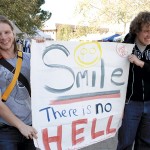
Last week, Tuesday, I noticed that my club, AAR, was counter-postering some heinous christian fundies.

You see, every once in a while there are these christian fellas with obnoxious signs like “Repent Sinners, You’re going to HELL!”, you know the kind I’m talking about. One of the smart fellas (I’m not sure who) that attends the club meetings suggested an interesting strategy for combating this type of demonstration. Every time one of the club members sees such signs, he should send out a text message alerting the rest of the group. We have already prepared counter-signs and keep them in storage. So, in only a few minutes we can effectively arrange a spontaneous counter demonstration.

But we still have to be marginally clever about our actions. We certainly don’t want to be too terribly offensive, or get anybody’s blood boiling. The trick is to maintain control at all times, and the easiest, most effective manner to do that is by promoting joviality. Our signs are targeted to promote humor. Rather than engaging the fundies in an argument (which, though entertaining, actively prolongs theirĀ presenceĀ on campus) we laugh at them. We fight their vitriol with humor. We refuse to give their arguments any weight or substance, and undermine their credibility with our smiles. We also lend our own views a sense of friendliness, in stark opposition to the fundies scare tactics. We allow them to goad us into portraying godlessness as warm and fuzzy.

Smile There is No Hell So, I passed by one of our counter-demonstrations last Tuesday. I didn’t have time to stop for long, but heard the story afterward. Apparently, after being out only for about a half hour, the fundies made a lame excuse about their meter running out of change (though Joe kindly offered to refill it for them) and left. We chased them off campus! And it was fun!

After the fundies had left, a reporter from the campus newspaper stopped by for a photo. Unfortunately, since the action had already taken place we have no accompanying article, only an image with the caption “The Happiest Little Demonstration” We also received several polite thank-you’s from moderate christians walking around campus. Apparently, everyone hates the evil sign people. I told my roommate about the event and he said that though he doesn’t agree with the text of our sign, chasing those guys off campus was a victory for all of humanity!

But this brings up an interesting point. I would consider that if someone who claims to be and considers themselves a member of your organization, then you have an obligations to encourage good behavior from that person, especially when they publicly represent you. The moderate christians aren’t really the problem in the world, it’s the extremists. Yet, I’d maintain that it’s up to the moderate factions to police the extremists. I know that many of the moderates are quite uncomfortable that a certain subset is promoting their belief system in an awfully negative light. But, being of the same community, its their responsibility to keep these people in check.

At the same time though, both because they are moderates (by nature, they are non-confrontational), and because they are ostensibly of the same belief system, they have fewer tools to work with. As members of the opposing side, it is we atheists, that wield the weapons to shut these fundies down. This, of course, places the moderate christians in a very awkward position. They incur alot of heat and wrath that the fundies encourage and spread, but are largely without recourse (they can’t act, but oh, but they can pray!). I pressed my roommate on this issue, and he said that though it’s been discussed at his christian meeting, nobody has any ideas on how to silence the fundies. I suggested adopting my groups strategy of counter-postering, but the methodology doesn’t quite transfer. The moderates own associations render them ineffective. Sure, the moderates are morally obligated to police the extremists, but they don’t have the tools to do so.

Speech on Chaos Theory and Ecological Stability

Posted by Eric Hennigan
On February 16th, 2009 at 16:02

Permalink | Trackback | Links In |

Leave a Comment |
Posted in Bio, Math, Self

I wrote this speech on the way to an Academic Decathlon competition in high school. I still like it, but see now that I really should have been speaking of path lines in attractor fields. Other than that very important mistake, and the fact that you have to have a good idea of what I’m discussing in the first place. I’d say it was a good speech for me at that time. I know the premise is wrong, I knew that when I wrote it. I just wanted to go against the popular opinion.


I’ve been hearing a lot lately about Global Warming, overpopulation, encroachment, and Deforestation. So far, scientists have predicted the hazardous effects that these problems have on the Earth. Although I’m not denying that we might harm the environment that sustains us, We cannot accurately predict what the effects of these actions might be, due to the fact that natural systems exhibit chaos in their cycles.

For example, consider a population consisting solely of wolves and rabbits. Within this population there exist a number of equilibriums. 1st; a constantly alternating number of wolves and rabbits. 2nd; a continuous and unchanging number of wolves and rabbits. and 3rd; the most stable of all, Death. Should we put this on a graph it would be evident that each of these existences or nonexistence, as the case may be, is “fighting for control” of the system. This results in a chaotic behavior of the system, as it oscillates between each of the 3 attractors.

On our graph of the wolf and rabbit population we can represent the system with a little dot in the middle of a complex attractor field. In this scenario there are 3 attractors, one for each equilibrium. Changes in the system due to human interaction and intervention can alter the placement of the system into the domain of a different attractor. Since we can never know everything that would be necessary to accurately graph the regions of the attractors, specifically the borders, we cannot predict what effects we really have on the environment, harmful or not.

All systems in nature from biological population to weather systems have a tendency to exhibit this type of chaos. In fact, without this ‘chaos’ the system wold probably collapse. It is through this principal of chaos that any changes made to the system are not cumulative, but are instead recoverable. The effect of the change is forever reduced, getting smaller and smaller until it finally disappears, instead of being progressively built upon until the entire system disintegrates.

As both events are possible, this leads to unpredictability. As we go about the simple act of living our daily lives, we necessarily and unavoidable affect the Earth and the environment in both obvious and undetectable ways. This may or may not be a danger. It is known for certain that we affect the environment but not known in what ways or to what extents. Both the slight and vast perturbations we make on natures systems affect the placement of the little dot in the middle of the graph such that it may succumb to another attractor entirely or merely go to a different spot within the same attractor.

Should I decide to shoot a rabbit and sell its feet as good luck charms the effects will definitely be felt by the system. Most likely the rabbit will be replaced, instead of causing a wold to starve and die, which may cause the rabbit population to explode unchecked, and so on until the entire balance is so upset that both populations die; all because one rabbit died prematurely. Doth events can conceivably take place, however we would expect the rabbit just to be replaced, from our experienced observations. The unpredictability lies in our disruption of the system in entirely different ways than we have done in the past.

All systems in nature exhibit this type of unpredictability. This chaos generally leads to the stability of the system but can sometimes means Death. Our actions that produce global warming, overpopulation, encroachment, and deforestation, have unpredictable effects on the environment. They could either cause chaos, disorder, and destruction, or the disruption could become smaller and smaller over time, until it eventually disappears.

Posters!

Posted by Eric Hennigan
On February 10th, 2009 at 18:02

Permalink | Trackback | Links In |

Leave a Comment |
Posted in Information Flow, Self

Posters about my current research (Information Flow in JavaScript) were accepted to Architectural Support for Programming Languages and Operating Systems (ASPLOS ‘09) and 2009 International Symposium on Code Generation and Optimization (CGO). This means that I have some work to do, and also that I get to meet and mingle with other interesting folk (one of the primary reasons that I went back to school). Hooray!

Unhappiness

Posted by Eric Hennigan
On February 9th, 2009 at 01:02

Permalink | Trackback | Links In |

Comments (1) |
Posted in Self

For some reason, quite unknown to me, I’ve been rather depressed lately. Normally, I coast through with a general state of melancholy, with entertaining, but superficial, jokes, comments, arguments, etc. This general state of contentment though has been displaced with a feeling of dissatisfaction.

The other day I went out to Laguna Beach, at a joint called the Crab Cooker, where my roomate’s band had a gig. I was generally miserable, but didn’t complain, because everyone else was having fun (or at least appearing to).

  1. I didn’t know any of the songs (they played mostly covers of popular songs, I’ve just been living under a rock my whole life and to a large extent have avoided popular culture entirely. I’ve also carried no musical interest.)
  2. The music was too loud. (It actually caused pain, this was true of all the places we visited after the gig was over. I should have brought earplug. I now know why so many have hearing problems when they get older.)
  3. I couldn’t talk to anyone. (This, to me is the only reason to go out with friends. To have a discussion. Loud anything get’s in the way of that.)
  4. I felt like a third wheel. (I felt largely out of place. Even if I could have talked, I didn’t have much to talk about. With the one exception being that I almost had a good conversation with my previous roomate, Colby, about culture and nationality/nationalism.)

So, those are the reasons why I mostly just bum around the house all day. But, I knew most of the above when I agreed to attend. So why did I attend? I thought it would be a nice gesture towards my roomate. I also considered that if I stayed home I’d be just as miserable (thought it might help with the depression).

But why would I be miserable if I stayed home? Because I’m almost always miserable when others that I live with are out having fun. This feeling becomes especially poignant when they are out late at night. I can’t sleep simply because I know they are out having fun, and I’m not. This is a personal psychosis, but knowing that it’s illogical hasn’t given me any clues to cure it.

I’ve been investigating lately, why It seems that I can’t be happy. I’m miserable if I stay, miserable if I go. It appears that I am actively making choices that cause me to be miserable. That I’m choosing not to be happy. Of course, I’m not alone in being unable to choose happiness; Apparently, everyone has a hard time making choices that result in their happiness. But, again, knowing this is true about human psychology, doesn’t give me any particular clues about how to choose better.

In the end, I remember being just exactly this miserable when I was doing my undergrad. I think the good things in my life are making me miserable.

  1. I’m back in an educational environment.
  2. I received a very nice complement from one of my professors. (We have to submit proposals for a class project, and after reading mine, he asked: “Do you have an advisor?”)
  3. Our last-minute poster submission to ASPLOS was accepted.
  4. I’ve got a presentation next week, that I’d like to do a good job at.
  5. It looks likely (if I put in the work) that the research I’ve been assigned can carry the funding of the Lab for awhile.
  6. It also looks like I can do some of the research with Brendan Eich (Inventor of JavaScript)
  7. I purchased for myself The Codex Seraphinianus

By all objective measurements I should be quite happy, if only a little stressed. But instead I feel miserable. I don’t reallyl understand it, even though I’ve been thinking about it all week, but I know it shall pass.